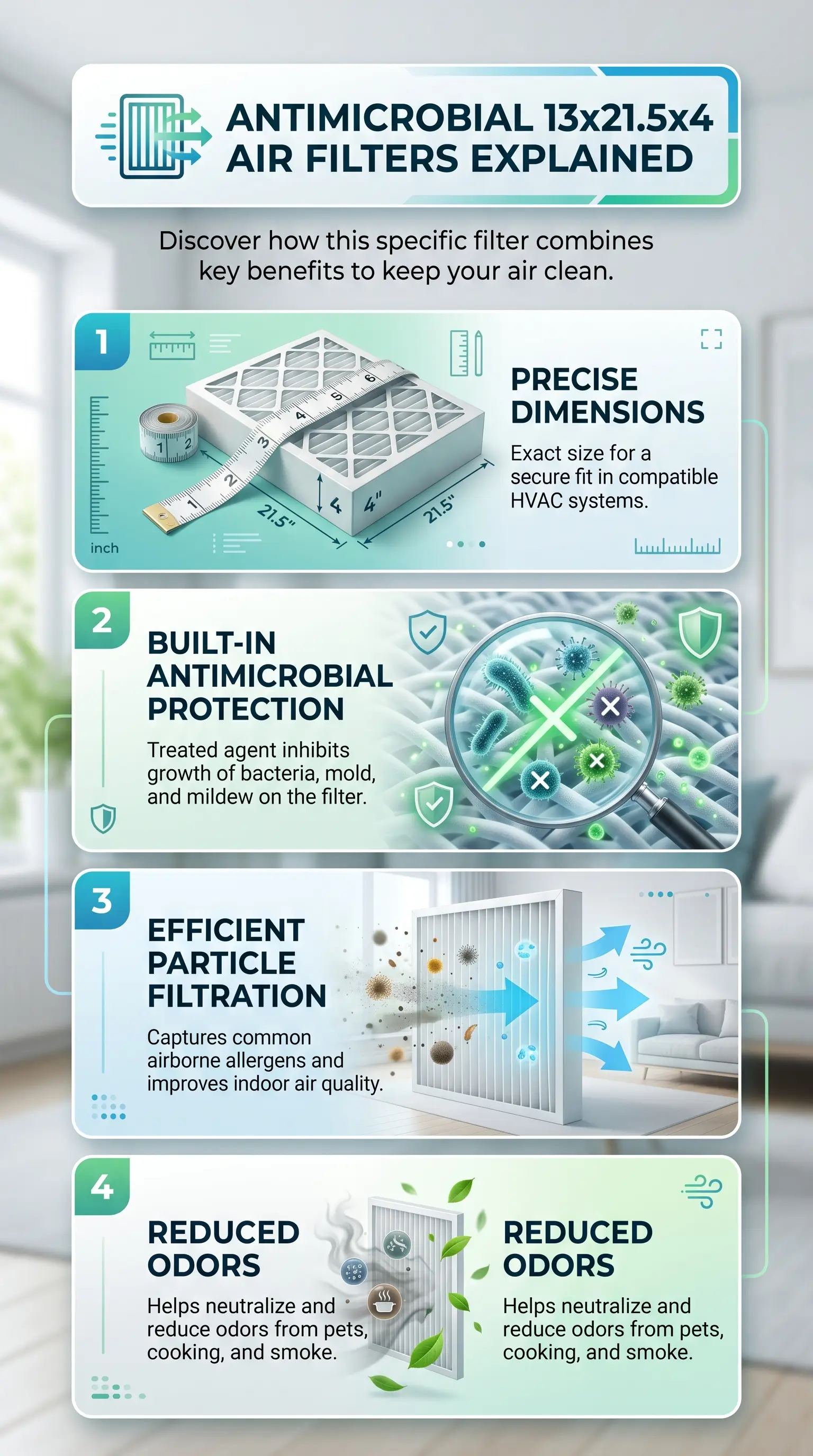
Pull the access panel off an AC in Weston in August. The filter you slide out isn't dusty. It's damp, and it smells.
That's the mold problem antimicrobial treatment solves. We've been manufacturing pleated media for over a decade, and we've put the same coatings through real humidity cycles. We know where the treatment earns its cost and where it doesn't.
Your air handler might take a 13x21.5x4, an actual-dimension slot found in some Trane, American Standard, and Carrier cabinets. That narrows your filter options fast. On days when outdoor air turns rough, whether from heavy pollen, a Saharan dust event, or the kind of bad-air day where you need to block wildfire smoke from drifting indoors, your filter is the first line.
TL;DR Quick Answers
What is it? A 4-inch pleated HVAC filter with an EPA-registered coating that slows mold, mildew, and bacteria growth on the media itself.
Who needs one? Homes in humid climates, households dealing with allergies or asthma, and any system running UV-C.
How long does it last? 6 to 9 months in Florida. Up to 12 months where the air is drier.
What MERV should I pick? MERV 11 covers most homes. Step up to MERV 13 if someone in the house has allergies and your system can handle the extra resistance.
Can I automate replacement? Yes. A filter subscription service ships new ones on schedule so you never forget.
Is there a washable version? Some reusable filter options exist, though they usually trade filtration efficiency for longevity.
Top Takeaways
Antimicrobial coating slows microbial growth on the filter media itself. It doesn't disinfect the moving airstream the way UV-C does.
13x21.5x4 is an actual dimension. It's not interchangeable with 13x21x4 or 14x21.5x4, so measure before you buy.
In humid climates, antimicrobial 4-inch filters usually last 6 to 9 months.
Pair antimicrobial media with MERV 11 or MERV 13. Before stepping up to 13, check a reliable MERV rating chart against your blower's static-pressure capacity.
Swap-outs take about five minutes. A short set of filter replacement instructions covers the full process.
What "Antimicrobial" Means on a Pleated Filter
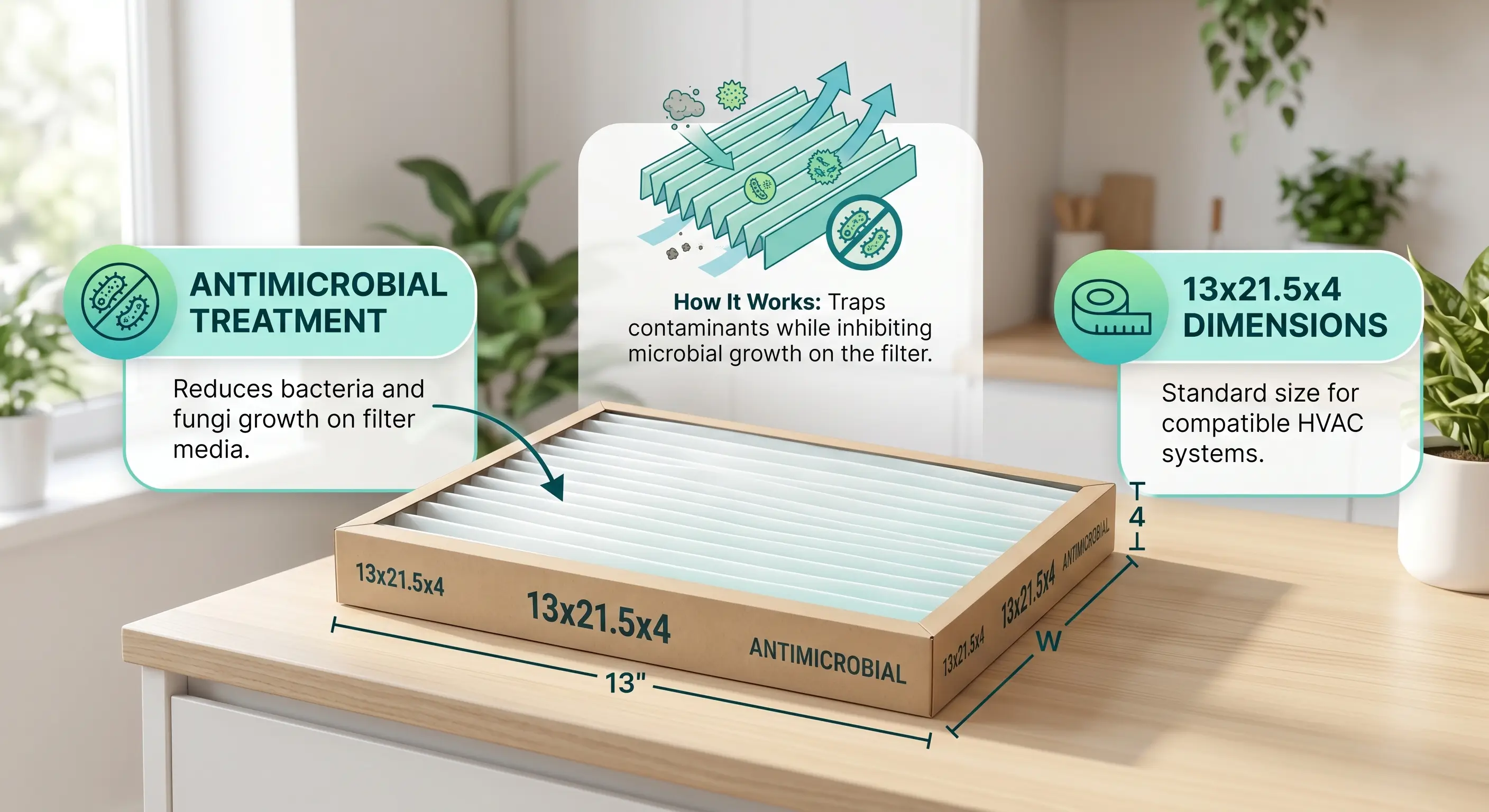
An antimicrobial 13x21.5x4 filter is a 4-inch-depth pleated air filter. The manufacturer treats the media with an EPA-registered biocide, usually a silver-ion compound or a bonded antimicrobial agent, that disrupts bacteria, mold spores, and mildew on the filter's surface. Some manufacturers publish an FPR rating guide alongside MERV. Both measure filtration performance on different scales. The coating doesn't zap contaminants out of the moving airstream the way a UV lamp does. It keeps microbes from setting up shop on the media between changes. That matters because a damp filter in a Florida air handler is a five-star hotel for mold.
Why the 13x21.5x4 Size Matters
13x21.5x4 is an actual-dimension filter, not a rounded nominal size. You'll find it in some 4-inch media cabinets from Trane, American Standard, and Carrier. It's one of the less familiar sizes, and you won't see it stocked alongside common filter sizes at most big-box stores. Drop in the wrong size (a 13x21x4 or a 14x21.5x4) and air slips around the gasket. Unfiltered air skips the media and dumps dust straight onto your evaporator coil.
Core Benefits
Mold and mildew resistance on the media — critical in humid regions where the filter stays damp between change-outs.
Bacterial growth reduction on the filter's surface between replacements.
More pleat area than a 1-inch filter, so the 4-inch depth holds more dust, pollen, and pet dander without choking airflow.
Longer service life, usually 6 to 9 months of South Florida runtime versus 1 to 3 months for a standard 1-inch.
Fewer "dirty sock" odors when the AC kicks on after a long humid night.
Picking the right efficiency level is its own call. If you're not sure which grade fits your household, this breakdown of the best home MERV levels is a good starting point.
How It Pairs With UV Light and Whole-System Care
UV-C lamps and antimicrobial filters aren't competitors. They're layered defense. The UV lamp neutralizes microbes as air passes the coil. The filter keeps microbes from colonizing the media itself. Before installing UV in an existing system, review the UV safety precautions so the lamps sit where they should and stay shielded from direct view. For the fullest effect, pair filtration and UV with regular duct cleaning services. A clean filter pulling air through a dirty return loses most of its value before it ever reaches your living room.
"Side-by-side field tests in Gulf Coast homes showed visible mold on untreated pleated media at the 90-day mark, while antimicrobial samples from the same homes came back clean. That's the difference a bonded coating makes in a humid climate."
7 Essential Resources
EPA — Indoor Air Quality (IAQ): The federal hub for indoor pollutant guidance, source control, and filtration strategy.
CDC — Asthma Data & Surveillance: National and state-level asthma statistics, including triggers and indoor risk factors.
NIEHS — Indoor Air Research: Peer-reviewed research from the National Institute of Environmental Health Sciences on indoor pollutants and long-term exposure.
ASHRAE — Technical Standards: The authority behind the MERV rating system (Standard 52.2) used to grade residential filter efficiency.
American Lung Association — Indoor Air Quality: Homeowner-friendly guidance on mold, allergens, and respiratory health.
ENERGY STAR — Heating & Cooling: Best practices for HVAC efficiency, including how filter restriction affects energy use.
Asthma and Allergy Foundation of America (AAFA): Guidance on allergen reduction inside the home, including the role of filtration.
3 Statistics You Should Know
Americans spend about 90% of their time indoors, where some pollutant concentrations run 2 to 5 times higher than typical outdoor levels. Source: U.S. Environmental Protection Agency.
Roughly 1 in 12 U.S. adults lives with asthma. About 65.9% of children with asthma also deal with allergies. Common indoor triggers like mold, dust mites, and pet dander aggravate both. Source: Centers for Disease Control and Prevention.
ASHRAE Standard 52.2, the national MERV rating system, tests filters on particles from 0.3 to 10 micrometers. That size range covers mold spores, bacterial clusters, and most common allergens. Source: ASHRAE.
Final Thoughts and Opinion
Antimicrobial treatment isn't magic, and it isn't a gimmick. It's a practical upgrade for homeowners running a 4-inch cabinet in a humid climate who want the filter to last through a full change cycle without smelling like a wet towel by month three.
In drier regions, standard pleated furnace filters without any coating will usually do the job. In Florida, the Gulf Coast, or anywhere your AC runs for most of the year, the small premium on antimicrobial media pays for itself the first time you open the cabinet and find clean pleats instead of dark spots. Households fighting seasonal allergies tend to do better with allergen defense models, while high-traffic homes carrying heavy dust loads lean toward dust defense filters. For a wider view of what's out there, this roundup of top furnace filters is a solid reference point. When you're ready to replace yours, we build these premium antimicrobial 13x21.5x4 air filters to order in the USA, at your system's actual dimension, in MERV 8, 11, and 13.
Frequently Asked Questions
Is an antimicrobial 13x21.5x4 filter safe for people with asthma or chemical sensitivities?
Yes. EPA-registered antimicrobial coatings bond directly to the fibers and don't off-gas into the airstream. People with asthma or allergies generally come out ahead, because the filter harbors less of the mold and bacteria that set off their symptoms.
Does an antimicrobial filter replace the need for a UV light?
No. They solve different problems. Antimicrobial treatment protects the media itself. UV-C lamps neutralize microbes as air moves past the coil. The two work best together.
How often should a 13x21.5x4 antimicrobial filter be replaced in Florida?
Every 6 to 9 months is the realistic range for year-round AC runtime. Homes with pets, smokers, or heavy pollen exposure should lean toward 6. Check the filter at 4 months to calibrate for your household.
Do I need MERV 13, or will a lower rating work?
For most homes without severe allergies, MERV 8 options handle everyday dust, pollen, and pet dander without straining the blower. Step up to MERV 11 or 13 if anyone in the household has asthma or environmental allergies.
Where's the best place to shop and compare?
Start with the manufacturer's direct site for actual-dimension accuracy and bulk pricing. Then cross-check marketplace listings to compare filter prices and confirm you're getting the size and MERV you expect.
What's the difference between 13x21.5x4 and 13x21x4?
Half an inch — and that half-inch matters. 13x21.5x4 is a specific actual size used in certain Trane, American Standard, and Carrier air handlers. Drop a 13x21x4 into a 13x21.5x4 slot and the gap lets unfiltered air bypass the media entirely.
Take the Next Step for Your Family's Air
Clean air isn't about comfort. It's about protecting your family, your home, and the HVAC system you've invested in. If your air handler takes a 13x21.5x4, the next filter you slide in is the easiest air-quality upgrade you'll make all year.
Measure twice, then order. Shop premium antimicrobial 13x21.5x4 air filters, built to order in the USA, shipped free, and guaranteed to fit your cabinet. Better Air For All starts in the cabinet you already own.
Learn more about HVAC Care from one of our HVAC solutions branches…
Filterbuy HVAC Solutions - Miami FL - Air Conditioning Service
1300 S Miami Ave Apt 4806 Miami FL 33130
(305) 306-5027
https://maps.app.goo.gl/Ci1vrL596LhvXKU79